Monday, 10 April 2017
UPDATE
The Great War at Sea Poetry Project will come to an end on the 30th April 2017. I would like to thank everyone from so many different countries who has visited the blog.
The posts on this blog will be archived at http://worldwarpoetry.com/ whilst anyone interested in World War 2 poetry is welcome to visit http://worldwar2poetry.blogspot.co.uk
Michael Bully
Brighton- 10th April 2017

Sunday, 4 December 2016
Vernon Watkins/Janet Hills
Last Post of 2016
Thank you to the large number of readers from many countries who have logged into the view this blog. Please also consider looking at the associated blog Worldwar2poetry.blogspot.co.uk
The latest post concerns Siegfried Sassoon's influence on World War 2 poets.
Vernon Watkins ( 1906- 1967), sometimes referred to as the 'other Welsh poet' due to his close association with Dylan Thomas. Thomas was due to be Vernon Watkins' best man, but missed the wedding ceremony .Vernon Watkins did a great service to sea poetry generally by translating the poetry of Heinrich Heine (1797- 1856) from German, appearing in the collection 'The North Sea ' (1955).
Watkins served in the RAF from 1941- 1945, including a spell with RAF Intelligence, and was stationed at Bletchley Park.
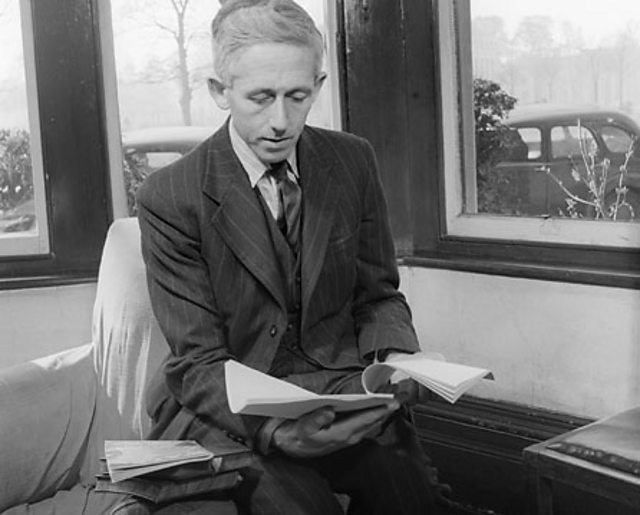
Vernon Watkins photograph (1948) from BBC Wales site
'Griefs of the Sea' was most probably written around 1940. The poem appeared in 'More Poems from the Forces- A Collection of Verses By Serving Members Of The Navy, Army and Air Force' edited by Welsh poet Keidrych Rhys in 1943, and dedicated to the USSR.
'Griefs of the Sea'- Vernon Watkins
Is it fitting to mourn dead sailors,
To crown the sea with some wild wreaths of foam
On some steep promontory, some corner cliff of Wales
Though the dead wave hear nothing.
It is fitting to fling off clothing,
To enter the sea with plunge of seawreaths white
Broken by limbs that love the waters, fear the stars,
Though the blind wave grope forward to the sand
With a greedy silvered hand.
It is a horrible sound, low wind's whistle
Across the seaweeds on the beach at night.
From stone to stone through hissing caves it passes
Up the curved cliff and shakes the prickly thistle
And spreads its hatred through the grasses.
In spite of that wicked sound
Of the wind that follows us like a scenting hounds,
It is fitting on the curved cliff to remember the drowned
To imagine them clearly for whom the sea no longer cares,
To deny the language of the thistle, to meet their foot -firm
tread
Across the dark-sown tares
Who were skilful (sic) and erect magnificent types of godhead,
To resist the dogging wind, to accuse the sea-god;
Yet in that gesture of anger we must admit
We were quarrelling with a phantom unawares.
For the sea turns whose every drop is counter
And sand turns whose every grain a holy hour-glass holds
And the weeds turn beneath the sea, the sifter life slips free,
And the wave turns surrendering from its folds
All things that are not of the sea, and throws off is the spirit
By the sea, the riderless horse which they once mounted.
The view of the sea, as a potentially hostile element, indifferent to the fate of humanity, is clearly evoked here. The sea 'no longer cares' about the drowned. The 'dead wave hear nothing' , there's also an image of a 'blind wave. There's also a mention of a 'sea-god' who isn't named, like some force one can not intercede with. Interesting how the wind is portrayed in the same bleak fashion. 'We were quarrelling with a phantom unawares', suggest Nature generally is not interested in negotiating with us.
' Autumn by the Sea'-Janet Hills
The Autumn's ashes here.
No warmth of berries, and the sunlight grieves
With no woods near.
The unescapable, the desolate sea,
Rigid through all its changes, deadens me,
And pale as Autumn seas, the scattered leaves
Break round the long-stalked flowers on homeless land
We loved to talk of peace,
And looked to see the rising of a truth
If war should cease.
Now, in the darkness, listlessly we guess
Towards some future blood-drained weariness.
For we , cut off from grace, must spend our youth
For something we abhor, but know must be.
From 'Shadows of War -British Women's Poetry of the Second World War' ,edited and introduced by Anne Powell, Alan Sutton Publishing, 1999.
Janet Hill is listed as an English graduate from Sommerville, then joined the WRVS, then became an officer in Intelligence. One collection of her work, titled 'Fragments', was published in 1956. So far haven't located any more of her work in World War 2 poetry anthologies, apart from one further poem in 'Shadows of War'. Particularly like the reference to the 'desolate sea/ Rigid through all its changes deadens me'. The sea is not portrayed as being hostile to the poet, but 'unescapable' (sic) , like the fact that the poet's generation is committed to fight an inevitable war. This sense of fatalism is typical of World War 2 poetry from Britain. Poetry is neither a tool for recruitment nor trying to enlighten non-combatants about the 'true' nature of war.
UPDATE
Thank you to the large number of readers from many countries who have logged into the view this blog. Please also consider looking at the associated blog Worldwar2poetry.blogspot.co.uk
The latest post concerns Siegfried Sassoon's influence on World War 2 poets.
Vernon Watkins ( 1906- 1967), sometimes referred to as the 'other Welsh poet' due to his close association with Dylan Thomas. Thomas was due to be Vernon Watkins' best man, but missed the wedding ceremony .Vernon Watkins did a great service to sea poetry generally by translating the poetry of Heinrich Heine (1797- 1856) from German, appearing in the collection 'The North Sea ' (1955).
Watkins served in the RAF from 1941- 1945, including a spell with RAF Intelligence, and was stationed at Bletchley Park.
'Griefs of the Sea' was most probably written around 1940. The poem appeared in 'More Poems from the Forces- A Collection of Verses By Serving Members Of The Navy, Army and Air Force' edited by Welsh poet Keidrych Rhys in 1943, and dedicated to the USSR.
'Griefs of the Sea'- Vernon Watkins
Is it fitting to mourn dead sailors,
To crown the sea with some wild wreaths of foam
On some steep promontory, some corner cliff of Wales
Though the dead wave hear nothing.
It is fitting to fling off clothing,
To enter the sea with plunge of seawreaths white
Broken by limbs that love the waters, fear the stars,
Though the blind wave grope forward to the sand
With a greedy silvered hand.
It is a horrible sound, low wind's whistle
Across the seaweeds on the beach at night.
From stone to stone through hissing caves it passes
Up the curved cliff and shakes the prickly thistle
And spreads its hatred through the grasses.
In spite of that wicked sound
Of the wind that follows us like a scenting hounds,
It is fitting on the curved cliff to remember the drowned
To imagine them clearly for whom the sea no longer cares,
To deny the language of the thistle, to meet their foot -firm
tread
Across the dark-sown tares
Who were skilful (sic) and erect magnificent types of godhead,
To resist the dogging wind, to accuse the sea-god;
Yet in that gesture of anger we must admit
We were quarrelling with a phantom unawares.
For the sea turns whose every drop is counter
And sand turns whose every grain a holy hour-glass holds
And the weeds turn beneath the sea, the sifter life slips free,
And the wave turns surrendering from its folds
All things that are not of the sea, and throws off is the spirit
By the sea, the riderless horse which they once mounted.
The view of the sea, as a potentially hostile element, indifferent to the fate of humanity, is clearly evoked here. The sea 'no longer cares' about the drowned. The 'dead wave hear nothing' , there's also an image of a 'blind wave. There's also a mention of a 'sea-god' who isn't named, like some force one can not intercede with. Interesting how the wind is portrayed in the same bleak fashion. 'We were quarrelling with a phantom unawares', suggest Nature generally is not interested in negotiating with us.
' Autumn by the Sea'-Janet Hills
The Autumn's ashes here.
No warmth of berries, and the sunlight grieves
With no woods near.
The unescapable, the desolate sea,
Rigid through all its changes, deadens me,
And pale as Autumn seas, the scattered leaves
Break round the long-stalked flowers on homeless land
We loved to talk of peace,
And looked to see the rising of a truth
If war should cease.
Now, in the darkness, listlessly we guess
Towards some future blood-drained weariness.
For we , cut off from grace, must spend our youth
For something we abhor, but know must be.
From 'Shadows of War -British Women's Poetry of the Second World War' ,edited and introduced by Anne Powell, Alan Sutton Publishing, 1999.
Janet Hill is listed as an English graduate from Sommerville, then joined the WRVS, then became an officer in Intelligence. One collection of her work, titled 'Fragments', was published in 1956. So far haven't located any more of her work in World War 2 poetry anthologies, apart from one further poem in 'Shadows of War'. Particularly like the reference to the 'desolate sea/ Rigid through all its changes deadens me'. The sea is not portrayed as being hostile to the poet, but 'unescapable' (sic) , like the fact that the poet's generation is committed to fight an inevitable war. This sense of fatalism is typical of World War 2 poetry from Britain. Poetry is neither a tool for recruitment nor trying to enlighten non-combatants about the 'true' nature of war.
UPDATE
Latest blog by Michael Bully Bleak Chesney Wold Charles Dickens/ 'dark' Victoriana launched February 2023
Tuesday, 8 November 2016
'Voices of Silence' -Vivien Noakes /The Poetry of J. L. Crommelin Brown
Greetings to readers of this blog in many countries, interest always appreciated. A companion blog to this one is World War 2 Poetry Blog
UPDATE the latest project from Michael Bully is Bleak Chesney Wold relating to Charles Dickens/ 'dark' Victoriana

His work 'Dies Heroica' war poems 1914-1918 featured such subjects as The Battle of Dogger Bank, the novelty of submarine warfare, war at sea in general, a tribute to Rupert Brooke, along with poems attacking German icons such as Krupps and Nietzsche. And J.L Crommelin Browns poetry managed to get ignored in subsequent anthologies until 'Voices of Silence' . In later years he became better known for playing cricket for Derbyshire. The poem 'Morphia' , written whilst the poet was recovering in hospital in 1916, is a neglected gem.
Will leave this post with some lines from J. L. Crommelin Brown's poem 'Troy' , written in April 1915, connecting Gallipoli with Antiquity,
‘Voices of Silence- The Alternative Book of First World War Poetry’ (2006) edited by Vivien Noakes was a landmark attempt to deliberately move away from the more established poets.
In her own words ;
“What I discovered was a body of rich, exciting, often deeply moving work that complements the established literary canon, the two should be read side by side “
Work by all serving ranks along with poems written by Conscientious Objectors and civilians was included in this anthology without distinction. There was no attempt to elevate certain poets above the others. Copies are still available and a kindle edition has been launched.
Vivien Noakes included a section on sea poetry. One favourite that was selected ;
Image taken from Pinterest - unsure of origin.
The Lusitania
" In a world that is neither night nor day,
A quiet twilight land.
With fifty fathoms over you
And the surge of seas to cover you,
You rest on the kindly sand.
Above, the earth is March or May,
And skies are fair in spring.
But all the seasons are one with you,
Summer and winter have done with you,
And wars, and everything.
Surely this is a goodly gift,
To sleep so sound and sure
That neither spite nor weariness,
Passion, nor pain, nor dreariness
Can touch you any more .
In drifting fume and flying scud,
When the great tides shoreward sweep,
The seas that are in all to you
Whisper and move and call to you.
Whisper and call and weep."
J.L. Crommelin Brown
One question that doesn't seem to be addressed now is what happens after the centenary ? It's now hundred and one years after the torpedoing of the 'The Lusitania' on 7th May 1915 with the loss of 1198 lives. Thought that it was worth selecting this poem deliberately out of sync with all the anniversary marking.
J.L ( John Lewis) Crommelin Brown (1888- 1953) fascinates me. Involved in the Cambridge Footnotes, where he was a university contemporary of Rupert Brooke,and later a commissioned officer in Royal Garrison Artillery in December 1915: Vivien Noakes placed him at the Western Front in February 1916 then invalided out of the Army in March 1916. Between May 1917 and July 1918 he was an instructor at the Cadet School at Trowbridge, and sent to Salonika in August 1918.
His work 'Dies Heroica' war poems 1914-1918 featured such subjects as The Battle of Dogger Bank, the novelty of submarine warfare, war at sea in general, a tribute to Rupert Brooke, along with poems attacking German icons such as Krupps and Nietzsche. And J.L Crommelin Browns poetry managed to get ignored in subsequent anthologies until 'Voices of Silence' . In later years he became better known for playing cricket for Derbyshire. The poem 'Morphia' , written whilst the poet was recovering in hospital in 1916, is a neglected gem.
“I eddy upwards towards a thing half-seen;
Sways like sea-currents, fluidly and green,
The flood of consciousness across my sight;
Till, one by one, the veils are stripped away;
The smoke of slumber blows away like dust;
And follows, sudden as a bayonet thrust,
The swift intolerable light of day.”
Text of Dies heroica
Will leave this post with some lines from J. L. Crommelin Brown's poem 'Troy' , written in April 1915, connecting Gallipoli with Antiquity,
For nigh three thousand years have rolled
Since Hector fought and Homer sung,
When Greece and all the world was young.


A nobler Navy breasts the waves,

Across the plain fresh armies go,
Once more above those quiet graves

From dusk to dawn the watch-fires glow.
Perchance some bugle faintly blown,

Some distant echo of the fight,
May bring them, sleeping there alone,

The memory of another night
When, black beneath the Southern Cross,
The lean ships came from Tenedos.
Thursday, 28 July 2016
Alan Ross, Murmansk, and 'Leaves in the Storm'
Murmansk and Leaves in the Storm
UPDATE latest project from Michael Bully is Bleak Chesney Wold Charles Dickens/ 'dark' Victoriana
launched February 2023
First of all, greetings to all the new visitors to this blog. Delighted to see individuals logging in from different countries, with a particular high number from both Russia and the USA.
Will start this entry with another poem by Alan Ross about the Allied Arctic Convoys to the USSR in World War 2.

HMS York on Arctic Convoy escort duty March 1942- acknowledgement due to Wikipedia Commons
Murmansk
" The snow whisper of bows through water
Asking and answer in their lift
And screw, ceremonials
Of salt and savagery
Burial of man and mermaid
On those last ski slopes
Voices still murmur
Ciels de Murmansk, ceilings, sea-eels,
Water-skiers with lovely backs
Arched before breaking.
I remember the thirst of Murmansk
The great eyelids of water.
Can one ever see through them ? "
" Ciels de Murmansk '(skies of Murmansk' in French), ceilings, sea-eels, " suggests the poet is using impressions and associations, could be an ironic song lyric.
But the first verse is far more striking, The Sea is an unbridled chaotic element swamping 'man and mermaid', overwhelming the sailors and their feeble mythical totems, like the sheer force of industrial warfare itself.
A difference between war poetry of World War 1 and World War 2 is that there is less comparison with a rural idyll in the latter. Men were fighting in the deserts of North Africa and on the Arctic coasts. There was a need to move fast , Nature was not represented by an idyllic passive countryside falling victim to War, but as another foe that was trying to stop progress. To be static meant becoming a target. In Ross' case, the longer the convoys were afloat, the more likelihood of being bombed from the air, menaced by mines, torpedoes or having to face enemy warships. There is no room to idealise the Sea that hampers a chance of reaching an environment that is less hostile such as the port of Murmansk,
Leaves in the Storm
Alan Ross wrote the following passage in prose form. Reminiscent of David Jones' epic 'In Parenthesis' (1937 ) that evokes the writer's service at Mametz Wood, on the Somme in 1916. Here Ross draws on his Arctic Convoy experience :
" The destroyers attack, drawing the enemy fire. Four swords of flame flick into the greyness like a fencer's blows. World is a small narrowing circle, squeezed smaller and smaller, time has been interrupted, the clock smashed. Red-flecked, world is reduced to the gunsight's orb, its still centre, a focal grey in a tilted world of sea and sky. It is too late to put the pieces together.
We are going in. Across our bows, suddenly, a welter of light, and expanding cone of sluiced sounds. Again and a shiver of steel. A moment of time displaced, the revolving bands interrupted. You didn't put the pieces together quickly enough. A storm of unleashed sound, shaken in a bowl of electric enclosure, a rainbow of light rocketing through the wrecked space, waves of explosion dancing in narrowing circles, within the eyes; and like a long snake unwinding, steam hissing out in a stream over everything."
Quote from page 179 of 'Leaves in the Storm'-a book of diaries edited with a running commentary by Stefan Schminski and Henry Treece : 1947 anthology featuring Alan Lewis, Gertrude Stein, Stephen Spender,Henry Miller, amongst others. )
The way that both natural forces such as 'a storm' , 'a rainbow' , 'waves' are integrated into an account of mechanised warfare at sea is most impressive. Even the rainbow, usually counted as representing natural beauty, becomes part of this battle narrative. Warfare and Nature are not separate but co-conspirators in causing mayhem.
The modernist idea of reporting , by writing in the present tense, draws the reader in an immediate fashion. A superb piece of war writing indeed.
---------------------------------------------------------------------------------------------
First of all, greetings to all the new visitors to this blog. Delighted to see individuals logging in from different countries, with a particular high number from both Russia and the USA.
Will start this entry with another poem by Alan Ross about the Allied Arctic Convoys to the USSR in World War 2.
HMS York on Arctic Convoy escort duty March 1942- acknowledgement due to Wikipedia Commons
Murmansk
" The snow whisper of bows through water
Asking and answer in their lift
And screw, ceremonials
Of salt and savagery
Burial of man and mermaid
On those last ski slopes
Voices still murmur
Ciels de Murmansk, ceilings, sea-eels,
Water-skiers with lovely backs
Arched before breaking.
I remember the thirst of Murmansk
The great eyelids of water.
Can one ever see through them ? "
" Ciels de Murmansk '(skies of Murmansk' in French), ceilings, sea-eels, " suggests the poet is using impressions and associations, could be an ironic song lyric.
But the first verse is far more striking, The Sea is an unbridled chaotic element swamping 'man and mermaid', overwhelming the sailors and their feeble mythical totems, like the sheer force of industrial warfare itself.
A difference between war poetry of World War 1 and World War 2 is that there is less comparison with a rural idyll in the latter. Men were fighting in the deserts of North Africa and on the Arctic coasts. There was a need to move fast , Nature was not represented by an idyllic passive countryside falling victim to War, but as another foe that was trying to stop progress. To be static meant becoming a target. In Ross' case, the longer the convoys were afloat, the more likelihood of being bombed from the air, menaced by mines, torpedoes or having to face enemy warships. There is no room to idealise the Sea that hampers a chance of reaching an environment that is less hostile such as the port of Murmansk,
Leaves in the Storm
Alan Ross wrote the following passage in prose form. Reminiscent of David Jones' epic 'In Parenthesis' (1937 ) that evokes the writer's service at Mametz Wood, on the Somme in 1916. Here Ross draws on his Arctic Convoy experience :
" The destroyers attack, drawing the enemy fire. Four swords of flame flick into the greyness like a fencer's blows. World is a small narrowing circle, squeezed smaller and smaller, time has been interrupted, the clock smashed. Red-flecked, world is reduced to the gunsight's orb, its still centre, a focal grey in a tilted world of sea and sky. It is too late to put the pieces together.
We are going in. Across our bows, suddenly, a welter of light, and expanding cone of sluiced sounds. Again and a shiver of steel. A moment of time displaced, the revolving bands interrupted. You didn't put the pieces together quickly enough. A storm of unleashed sound, shaken in a bowl of electric enclosure, a rainbow of light rocketing through the wrecked space, waves of explosion dancing in narrowing circles, within the eyes; and like a long snake unwinding, steam hissing out in a stream over everything."
Quote from page 179 of 'Leaves in the Storm'-a book of diaries edited with a running commentary by Stefan Schminski and Henry Treece : 1947 anthology featuring Alan Lewis, Gertrude Stein, Stephen Spender,Henry Miller, amongst others. )
The way that both natural forces such as 'a storm' , 'a rainbow' , 'waves' are integrated into an account of mechanised warfare at sea is most impressive. Even the rainbow, usually counted as representing natural beauty, becomes part of this battle narrative. Warfare and Nature are not separate but co-conspirators in causing mayhem.
The modernist idea of reporting , by writing in the present tense, draws the reader in an immediate fashion. A superb piece of war writing indeed.
---------------------------------------------------------------------------------------------
Thursday, 7 July 2016
More about Alan Ross
Arctic Waking -Alan Ross
.jpg)
'HMS Glorious' by Eric Ravillious -courtesy of the Imperial War Museum (Art.IWM ART LD 283 )
Arctic Waking
Sky like a dog rose draws blood,
The tide mirrors my sailed love,
Through clouds of sea foamed green;
The white gull fastens on the skyline.
Foam-flecked the mooned wake curves,
an ocean grown white with roses,
Recessions of suns draw tides, coppering
The sea's back, the scalloped hair of mermaids.
Shells bear retentive music through husks
Of night; my love's hair floats green, like
Some Ophelia's cold and wild the flowers
Of her eyes scattered under black water.
The free gull moves across white horses.
The dream grows dry with frozen thirst.
As dawn, the convoy alters course;
The sun comes up and slowly bursts.
---------------------
Alan Ross ( 1922- 2001) served in the Royal Navy during World War 2, including a spell on the Arctic convoys. A newspaper columnist, travel writer, member of naval intelligence, ardent cricket fan, editor of ' London Magazine' Ross 'first book of poems The Derelict Day ( 1947) concerned Germany immediately after World War 2, an anthology Something of the Sea followed in 1954 -though only a third of the poems relate to the sea, and a number of them were reproduced in a subsequent collection Open Sea (1978). The poem 'Survivors' has already been covered by a blog entry from September 2015 and 'Arctic Waking' is also from Something ...
Particularly like way this poem weaves from the credible ' Through clouds of sea foamed green' through to the unreal ' An ocean grown white with roses' . Also the folksy ballad lyric referencing 'my sailed love' and 'my love's hair' along with an almost schoolboy interest in Ophelia , the drowned lover in stagnant water most famous from the Pre-Raphaelite painting by Sir John Everett Millais ( completed in 1852) displaced into a northern sea is peculiar . The notion that its the sun rather than the moon 'drawing tides' ...well the impressions seem to be tumbling. Then the enchantment of the night is broken by the convoy altering its course at dawn, confronting an exploding sun.
I chose this poem because its slightly surreal. But also because from a historical point of view it tells us nothing about the nature of war. By contrast Alan Ross could write poems that are far more specific, such as the epic 'J.W.51B A Convoy' , with lines such as
'Courses crossing, like lines on a hand,
Darkness disintergrating, and throwing up
Into the net of the morning, life fish,
A stranded sea of vessels, ignorantly
Approaching, British and German '.
Yet, it's important to break the habit of somehow grading war poetry on the basis of what it tells us about war. 'Arctic Waking' arguably records the jumbled impressions of a young well educated man under pressure, whose still learning his craft as a poet. Perhaps the proverbial 'baptism of fire' , and a sense of the exploding sun wrecking everything else is evoked at the end of the poem. Perhaps not.
The title of Something of the Sea is taken from a poem -'Loves Still Has Something of the Sea' by Sir Charles Sedley , a Restoration poet, playwright and disgraceful drunk,
'Love still has something of the sea,
From whence his Mother rose'

Alan Ross- taken from 'Google Images'
Love still has something of the Sea-Sir Charles Sedley (1639 -1701)
Love still has something of the sea,
From whence his Mother rose;
No time his slaves from doubt can free,
Nor give their thoughts repose.
They are becalm'd in clearest days,
And in rough weather tost;
They wither under cold delays,
Or are in tempests lost.
One while they seem to touch the port,
Then straight into the main
Some angry wind in cruel sport
Their vessel drives again.
At first disdain and pride they fear,
Which, if they chance to 'scape,
Rivals and falsehood soon appear
In a more dreadful shape.
By such degrees to joy they come,
And are so long withstood,
So slowly they receive the sum,
It hardly does them good.
'Tis cruel to prolong a pain;
And to defer a joy,
Believe me, gentle Celemene,
Offends the winged boy.
An hundred thousand oaths your fears
Perhaps would not remove,
And if I gaz'd a thousand years,
I could no deeper love.
------------------------------------------------------------------------------------------------------------------
New Blog launched by Michael Bully, February 2023 Bleak Chesney Wold Charles Dickens/ 'dark' Victoriana
Sunday, 29 May 2016
Jutland Centenary 1916- 2016
Remembering all those who died at the Battle of Jutland/Skaggerakslacht
31st May/1st June 1916.

YEARS AHEAD:
YEARS ahead, years ahead,
Who shall honour our sailor-dead ?
For the wild North Sea, the bleak North Sea,
Threshes and seethes so endlessly.
Gathering foam and changing crest
Heave and hurry, and know no rest :
How can they mark our sailor-dead
In the years ahead ?
Time goes by, time goes by,
And who shall tell where our soldiers lie ?
The guiding trench-cut winds afar,
Miles upon miles where the dead men are;
A cross of wood, or a carven block,
A name-disc hung on a rifle-stock
These shall tell where our soldiers lie
As the time goes by.
Days to come, days to come
But who shall ask of the wandering foam,
The weaving weed, or the rocking swell,
The place of our sailor-dead to tell ?
From Jutland reefs to Scapa Flow
Tracks of the wary warships go,
But the deep sea-wastes lie green and dumb
All the days to come.
Years ahead, years ahead,
The sea shall honour our sailor-dead !
No mound of mouldering earth shall show
The fighting place of the men below,
But a swirl of seas that gather and spill;
And the wind's wild chanty whistling shrill
Shall cry " Consider my sailor-dead! "
In the years ahead.
GUY N. POCOCK.
(From Page 100 of 'Modern Poetry' edited by Guy N. Pocock . (1920) )
Have quoted from this poem before but it seems so appropriate. And today 'our sailor dead' should refer to the men who fought on both sides. And in the spirit of reconciliation, both between peoples and nations, and the different aspects of sea poetry, will quote from Heinrich Heine (13th December 1797- 17th February 1856) .
I hail thee, O Sea, thou Ancient of Days!
Like speech of my homestead murmurs thy water,
Like dreams of my childhood shimmer before me
The heaving leagues of thy billowy realm,
As Memory, the grey-beard, remurmurs his stories
Of all those dear magnificent playthings,
Of all those glittering Christmas-presents,
Of all those branchy red trees of coral,
Gold-fishes, pearls, and shimmering sea-shells,
Which thou mysteriously dost guard
Down there in thy lucid crystal house.
From 'The North Sea- Second Cycle', translated by John Todhunter , from the superb 'All Poetry' website.
Here the sea is cited as a powerful but enchanting element. An association with war wouldn't necessarily have been made by a 19th century romantic such as Heine : The notion that the North Sea was a potential background was to re-emerge during the Great War.
Permission had been sought to us the picture at the top of the post , The 'Battle of Jutland May 31st 1916 Christmas Card' by Bernard Gribble , as not clear if it's in the public domain .
UPDATES
The original intention of the Great War at Sea Poetry Project was to have an anthology of such poems published to commemorate the centenary of Jutland. This has not quite happened. But in the last two years the Blog and Website nevertheless have made a contribution to generating interest in lesser known war poetry and I wish to thank all supporters of the blog and website.
The remit of the Project will now extend to cover War at Sea Poetry generally.
The main Great War at Sea Poetry Project website has now been updated : A new webpage has been added featuring World War 2 serving poet Charles Causley's Jutland poem 'Ballad of John Cornwell'
Jack Cornwell
Previous webpage on the battle from 2014
Jutland
The Great War at Sea Poetry Project is now on Twitter :
MichaelBully @waratseapoetry1
Thursday, 28 April 2016
Remembering the Fishermen who served during the Great War
Fishermen Against the Kaiser Shockwaves of War- 1914- 1915

Was grateful to hear Saltdean based historian Douglas d'Enno talk about his 2010 book 'Fishermen Against the Kaiser-Shockwaves of War 1914- 1918 -Volume 1' ( 'Pen and Sword', 2010)
A fascinating work indeed. A vital contribution to understanding the Great War at Sea. The focus is on 1914-1915 with a second volume still to be published.The writer’s extensive use of source material, with clear cross referencing, is admirable.
Douglas d'Enno's case is that the outbreak of war took fishing fleets on both sides by surprise,though soon they would be seizing each other's boats. Also that the Royal Navy was at first quite suspicious of fishermen.
Initially there was a concern that fishing boats and their nets could get in the way of Royal Navy activity. Moreover, lack of fishing boat activity in certain stretches of water would highlight minefields’ location to the enemy. On 25th August 1914 whole swathes of the English Channel and the North Sea were closed to the fishermen. And the market was in danger of stagnation.
Yet fishermen were soon involved in the war. Large numbers joined the Royal Navy Reserves. Others assisted in evacuating Belgian refugees. And significantly
“During the war no fewer than 1,455 trawlers, 1372 steamdrifters, and 118 motor drifters were pressed into naval service. Nor should the humble smack be forgotten, for a number were assigned to special duties-.....” ( page 41) Admiral Beresford is given the credit for realising the potential of the fishermen in the war effort.
And for those who remained at sea, life became increasingly dangerous. For example at the end of August 1915, the Boston fishing fleet, accompanied by some vessels from Grimsby, encountered German warships. Fifteen ships were sunk and the men were taken as prisoners of war.
Fishermen seemed particularly useful on board minesweepers. They served in the Dardanelles just before the Gallipoli landings and in the Adriatic, also on a sortie to Zeebrugge on 23rd August 1915.
Former fishermen performed courageous acts rescuing survivors of U boat shelling such as when the U9 torpedoed three battle cruisers, or during the Lusitania sinking, amongst others. But there were also times that the fishermen would not always succumb to naval discipline with examples of insubordination and unruly behaviour being reported. But overall this writer honours fishermen who lost their lives on account of the war, and how quickly they adapted to serve.
A further strength of this book is that it covers other lesser known issues such as the use of Crystal Palace as a naval training ground, inflation during World War 1, the wretched plight of fishermen captured by the Germans, the number of Scottish women who moved to East Anglia to work for the fisheries.
Looking forward to Volume 2.
|
The writer includes extracts from lesser known poetry at the start of each chapter; Contemporary work from 'Punch', Alice Brooks, Geoffrey Dreamer, along with World War 2 poet Michael Thwaite. Dreamer's work has been covered elsewhere on this blog ; however was previously unaware of Joseph Powell's poem 'Night at Ruhleben' . Ruhleben was a German camp housing a large number of interned British citizens and captured British sailors. Joseph Powell was elected as camp captain.
It's also helpful to be reminded of the work of naval historians from the 1920's who are overlooked now such as E.Keble-Chatterton and Lowell Thomas. From reading 'Fishermen Against the Kaiser' , got to learn about 1918 work titled ' Fishermen in War Time' by Walter Wood.
Now available on line
Fishermen in war time -text
As a tribute to the fishermen who served during the Great War ,felt appropriate to post an extract from a poem by one 'H. Ingamells' titled 'The Minesweepers ' which first appeared in an anthology 'These were the men poems of the war 1914- 1918 ' (from 1919), also cited by Douglas d'Enno .
Starts on page 81 Text-These were the men
Little they care, come wind or wave,
The men of Grimsby Town,
There are mines to destroy, and lives to save,
And they take the risk, these sailormen brave,
With a laugh and a joke, or a rollicking stave,
As the gear goes plunging down.

Honour the trawler's crew,
For fear they never knew !
Now on their quest they go
With measured tack and slow
Seeking the hidden fate
Strewn with a devilish hate.

Death may come in a terrible form,
Death in a calm or death in a storm,
Death without warning, stark and grim,
Death with a tearing of limb from limb,
Death in a horrible, hideous guise :
Such is the mine-sweeper's sacrifice !
Careless of terrors and scornful of ease,
Stolid and steadfast, they sweep the seas.

Cheerfully, simply, fearlessly,

The men of Grimsby Town,
Do their bit on the rolling sea
The storm-swept, treacherous, grey North Sea
Doing their duty unflinchingly,
Keeping the death rate down.
Subscribe to:
Posts (Atom)